Japanese Food Guide for First Timers: What to Eat (and How to Order)
Japanese food is one of the best things about visiting Japan. That sounds like an obvious statement, but I mean it in a specific way: the food culture here is so different from anywhere else that it warrants its own preparation. Knowing what to order, where to find it, and how to navigate a restaurant that has no English menu makes the entire experience dramatically better.
This guide covers the essential dishes you should try, realistic prices, how to order in various types of restaurants, and a few things first-timers always get wrong.
—
How Restaurants Work in Japan
Before getting into specific dishes, it helps to understand the different types of Japanese restaurants and how each one operates. Getting this wrong leads to awkward moments or worse, going hungry because you did not understand the system.
Ticket Machine Restaurants (Shokken)
Many casual restaurants – ramen shops, tonkatsu joints, curry houses, udon chains – use a ticket vending machine at the entrance. You look at the buttons (usually with photos), choose your dish, pay cash or IC card, receive a ticket, then hand it to the staff when you sit down.
Tips for ticket machines:
– Look for a button that says “English” if you cannot read Japanese
– Most machines now have photo displays
– If the machine takes only cash, there is usually a change machine nearby
– Do not be embarrassed to point at the display photos – staff expect it
Counter Dining
A huge amount of Japanese food is eaten at counter seats facing the open kitchen. Ramen, sushi, tempura, and soba restaurants often use this setup. Sit down, look at the menu (often laminated with photos), point or say the name of your dish, and wait.
The phrasing “kore wo hitotsu kudasai” (one of this, please) while pointing works universally.
Self-Service (Famiresu / Family Restaurants)
Chain family restaurants like Gusto, Denny’s Japan, and Jonathan’s have table-side tablets where you order by tapping photos. These are great for first-timers with zero language barrier.
High-End Restaurants
For upscale omakase sushi, kaiseki, or teppanyaki, reservations are typically required. Many of the best places now accept reservations through Tableall, Omakase, or directly via email in English. Prices range from 10,000 JPY (about $65 USD) per person up to 50,000 JPY+ ($330+ USD) at the very top end.
—
The Essential Dishes
Ramen
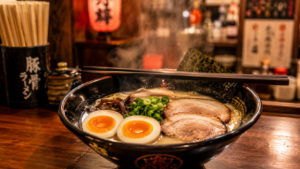
Ramen is arguably the dish most foreign visitors are most excited about, and Japan does not disappoint. It is cheap (600-1,200 JPY / $4-8 USD), filling, and endlessly varied by region.
The four main styles:
– Shoyu (soy): Clear brown broth, lighter flavor. Tokyo-style.
– Miso: Rich, savory, thick broth. Common in Hokkaido and Sapporo.
– Tonkotsu: Creamy pork bone broth, heavy and rich. Fukuoka/Hakata style.
– Shio (salt): Clear, light broth. Often with seafood or chicken.
Where to eat ramen: Dedicated ramen shops (search for lines outside – that is almost always a reliable indicator). Avoid the tourist-trap ramen museum chains and find a local one instead. Ichiran and Ippudo are solid chain options available in most cities.
Etiquette note: Slurping is not just acceptable, it is expected. Slurping is said to cool the noodles and enhance the flavor. Do it.
Sushi
Sushi in Japan is nothing like sushi in your home country. Even cheap conveyor belt sushi (kaiten-zushi) here is worlds better than mid-tier sushi abroad.
Conveyor belt sushi (kaiten-zushi): 110-330 JPY per plate ($0.75-$2.20 USD). Color-coded plates represent different prices. You grab what passes by or order via tablet. Sushiro, Hama Sushi, and Kura Sushi are excellent chains.
Neighborhood sushi: A proper sit-down sushi lunch costs 1,500-3,000 JPY ($10-20 USD) and is genuinely memorable. Dinner omakase starts around 8,000 JPY ($53 USD) at mid-tier places.
Ordering note: At counter sushi, you can point at the fish display case and say “kore wo hitotsu” (one of that) or simply point. The chef will make it in front of you.
Tempura
Lightly battered and deep-fried vegetables and seafood. The batter should be thin and almost translucent – nothing like heavy Western fried food.
A tempura set (teishoku) at a casual tempura restaurant: 1,000-2,000 JPY ($7-13 USD). It comes with rice, miso soup, pickles, and a dipping sauce.
Tonkatsu
Breaded and fried pork cutlet. Think of a Japanese wiener schnitzel. Served with shredded cabbage, miso soup, and a thick Worcestershire-based sauce.
Casual tonkatsu set: 900-1,500 JPY ($6-10 USD). Katsu Curry (tonkatsu on a bed of Japanese curry and rice) is one of the most satisfying cheap meals in Japan.
Yakitori
Chicken (and other things) on skewers, grilled over charcoal. Served in dedicated yakitori restaurants or izakayas. Each skewer costs 150-400 JPY ($1-2.70 USD).
Order by pointing at the menu or display, or try these:
– Momo – thigh meat
– Negima – chicken and spring onion
– Tsukune – chicken meatball
Udon
Thick wheat noodles in a clear dashi broth. Cheap, filling, and widely available. Marugame Seimen is an excellent self-service udon chain found across Japan – a full bowl with tempura costs under 800 JPY ($5.30 USD).
Hot vs cold: In summer, try cold udon (zaru udon) – the noodles are firmer and served with dipping sauce on the side.
Soba
Thin buckwheat noodles, nutty in flavor. Available hot or cold. Zaru soba (cold soba with dipping sauce) is one of the most elegant simple meals in Japan. Most soba restaurants are casual and cheap: 800-1,500 JPY ($5.30-10 USD).
Okonomiyaki
A savory pancake-style dish made with cabbage, egg, and your choice of protein, covered in a sweet sauce and Japanese mayo. The name roughly translates to “cook what you like.”
Most popular in Osaka and Hiroshima (where they do a layered version). Price: 800-1,500 JPY ($5.30-10 USD).
In some restaurants, you cook it yourself on a teppan griddle at your table – staff will usually demonstrate if you look confused.
Takoyaki
Osaka’s most iconic street food. Golf ball-sized spheres of batter filled with octopus pieces, topped with sauce, bonito flakes, and mayo. Sold from street stalls and dedicated shops for 500-800 JPY ($3.30-5.30 USD) for a set of 6 or 8.
Warning: Takoyaki is served at near-scalding temperature inside while appearing cool outside. Bite carefully.
Gyoza
Pan-fried dumplings, usually pork and cabbage. Often eaten as a side dish with ramen but available as a standalone. An order of 6 gyoza typically costs 300-500 JPY ($2-3.30 USD).
Japanese Curry
Japanese curry is gentler and sweeter than Indian or Thai curry. Typically pork, beef, or chicken over rice, with sides like fukujinzuke (pickled vegetables). CoCo Ichibanya is the biggest curry chain and one of the most reliable cheap meals anywhere in Japan: 800-1,200 JPY ($5.30-8 USD).
—
Convenience Store Food (Konbini)
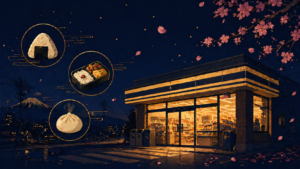
Japan’s convenience stores – 7-Eleven, Lawson, and FamilyMart – are genuinely good food options. I eat konbini food at least once every Japan trip and feel zero shame about it.
The best konbini items:
– Onigiri (rice balls): 110-180 JPY ($0.75-1.20 USD). The salmon and tuna mayo are classics.
– Hot snacks: Karaage chicken, nikuman (steamed pork bun), fish cakes – all cooked and sitting by the register
– Sandwiches: Egg salad on milk bread. Sounds boring. Tastes extraordinary.
– Instant ramen (prepared in-store): Many konbini have hot water dispensers
– Oden: Simmered items in a dashi broth, available from the heated vat by the register in autumn and winter
Read the dedicated Japan convenience store guide for the full breakdown of what to buy and how to use konbini to their full potential.
—
Useful Food Vocabulary
| Word | Meaning |
|---|---|
| Teishoku | Set meal (comes with sides) |
| Omakase | Chef’s choice |
| Tabehoudai | All-you-can-eat |
| Nomihoudai | All-you-can-drink |
| Okawari | Refill |
| Nuki de | Without (as in “negi nuki” = no spring onion) |
—
Price Reference Table
| Dish | Budget | Mid-Range | High-End |
|---|---|---|---|
| Ramen | 600 JPY ($4) | 900 JPY ($6) | 1,500 JPY ($10) |
| Sushi – kaiten | 500 JPY ($3.30) | 1,000 JPY ($6.60) | – |
| Sushi – sit-down | 1,500 JPY ($10) | 3,000 JPY ($20) | 20,000+ JPY ($133+) |
| Udon | 400 JPY ($2.70) | 800 JPY ($5.30) | 1,500 JPY ($10) |
| Tempura set | 1,000 JPY ($6.60) | 1,800 JPY ($12) | 5,000 JPY ($33) |
| Yakitori | 150 JPY/skewer | 300 JPY/skewer | 600 JPY/skewer |
| Takoyaki | 500 JPY ($3.30) | 700 JPY ($4.60) | – |
| Curry rice | 700 JPY ($4.60) | 1,000 JPY ($6.60) | 2,000 JPY ($13) |
—
Common Mistakes First-Timers Make
Tipping: Do not. Tipping is not part of Japanese culture and can actually cause confusion or mild offense. Excellent service is standard – it does not require additional compensation.
Eating while walking: Generally frowned upon. Street food stalls at festivals and places like Asakusa are exceptions where eating standing nearby is fine. Avoid walking and eating in Kyoto especially.
Not saying anything when you sit down: When you enter most Japanese restaurants, staff will call out “irasshaimase!” (welcome). You do not need to respond, but a nod or smile is appreciated. When seated, saying “sumimasen” to flag a staff member is the standard way to get attention.
Being afraid of the ticket machine: The machine is your friend. Take your time, use the photo buttons, and do not hold up the line by overthinking it. Buy your ticket, sit down, hand it over. That is the whole process.
—
Final Thoughts
Japanese food is one of those things that is almost impossible to overstate. Even meals that seem ordinary – a bowl of udon at a highway rest stop, a 7-Eleven onigiri eaten on a train platform – are often better than the best versions of that food you have had at home.
Go in with curiosity, be willing to point at things you do not recognize, and do not be afraid of the ticket machine. The worst case is you end up with something you did not expect, and in Japan, that unexpected dish is usually still excellent.
Related reading:
– Japan convenience store guide