Japan Travel Guide for Americans: Everything You Need to Know (2026)
Japan has become one of the most popular international destinations for Americans — and it’s easy to see why. The food, the efficiency, the culture, the nature, and the safety make it unlike anywhere else in the world. With the right planning, Japan is also significantly more affordable than most Americans expect.
This guide covers everything an American traveler needs to know before and during a trip to Japan in 2026.
—
Visa: Do Americans Need One?
No. US citizens enjoy visa-free entry to Japan for up to 90 days under the Japan-US reciprocal visa waiver agreement. This applies to tourism, short business trips, and visiting family.
Requirements:
– Valid US passport (must be valid for your entire stay)
– Return or onward flight ticket
– Proof of sufficient funds (rarely checked but good to have)
– No criminal history
There is no registration, no application, no fee. You simply present your passport at immigration. Americans get a stamp and proceed.
—
Flights from the US to Japan
Japan has two main international airports: Tokyo Narita (NRT), Tokyo Haneda (HND), and Osaka Kansai (KIX) for Western Japan.
Flight times from major US cities:
| Departure | Destination | Approx. Duration | Common Airlines |
|---|---|---|---|
| Los Angeles (LAX) | Tokyo (NRT/HND) | ~11–12 hours | ANA, JAL, United, Delta |
| San Francisco (SFO) | Tokyo (NRT/HND) | ~10–11 hours | ANA, JAL, United |
| New York (JFK) | Tokyo (NRT/HND) | ~14 hours direct | ANA, JAL |
| Chicago (ORD) | Tokyo (NRT/HND) | ~13 hours | ANA, United |
| Seattle (SEA) | Tokyo (NRT/HND) | ~10 hours | ANA, Delta, JAL |
| Houston (IAH) | Tokyo | ~13 hours | ANA, United |
West Coast travelers have a significant advantage — roughly 10–11 hours versus 14+ from the East Coast.
Budget tip: LAX-Tokyo on ANA or JAL runs ~$700–$1,100 in economy depending on season. Book 3–6 months in advance for the best fares. February and November are typically the cheapest months to fly.
—
When to Go: Seasons for American Travelers
| Season | Months | Highlights | Crowds | Price |
|---|---|---|---|---|
| Cherry blossom | Late March–April | Stunning blooms | Very high | High |
| Summer | July–August | Festivals, fireworks | High | Moderate |
| Autumn | October–November | Fall foliage | High | High |
| Winter | December–February | Snow, fewer crowds, illuminations | Low | Low |
| Rainy season | June | Hydrangeas, green landscapes | Low | Low |
For Americans with school-year constraints, summer is popular — but June (rainy season) offers great value and fewer tourists.
—
USD Budget for Japan
Japan’s current exchange rate is favorable for American travelers. As of 2026, roughly ¥150–155 = $1 USD.
Daily budget estimates:
| Budget Level | Daily Spend | What You Get |
|---|---|---|
| Backpacker | $40–$60 | Hostel dorm, konbini meals, limited paid attractions |
| Mid-range | $80–$120 | Private room, mix of restaurants and konbini |
| Comfortable | $150–$200 | Business hotel, restaurant dining, day trips |
| Luxury | $250+ | Ryokan, omakase, private tours |
For a full breakdown: How Much Does 1 Week in Japan Cost?
—
Power Adapters and Electricity
Japan runs on 100V / 60Hz in the west (Tokyo: 50Hz). US appliances are 120V, so most modern electronics (phones, laptops, cameras) handle the slight voltage difference fine.
Plug type: Japan uses Type A plugs — the same two flat-prong plug used in the US. You do NOT need a plug adapter. Just bring your regular US chargers.
—
Cash vs. Cards in Japan
Japan is historically cash-heavy, though card acceptance is improving rapidly:
– 7-Eleven, FamilyMart, and Lawson ATMs accept foreign Visa/Mastercard debit and credit cards
– Many restaurants, shrines, and small shops still prefer cash
– Withdrawal fees: Typically ¥110–220 per transaction at convenience store ATMs
Recommendation: Withdraw ¥30,000–50,000 when you arrive and keep cash available at all times. Read the full guide: Japan Money Guide: Cash, Cards, ATMs, and Currency Exchange
—
Getting a SIM or eSIM
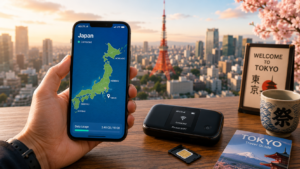
Do not rely on US carrier roaming — it’s expensive and often throttled. Get a Japan eSIM or local SIM before or after arrival.
See our dedicated guide: Best eSIM for American Travelers to Japan or the full eSIM/pocket Wi-Fi comparison: Best eSIM and Pocket Wi-Fi for Japan (2026)
—
Getting Around Japan
Japan’s rail network is one of the best in the world. As an American, getting comfortable with the train system early makes your whole trip easier.
Read the full guide: Japan Train Guide for Beginners
Should you get a JR Pass? For most Americans doing a standard Tokyo-Kyoto-Osaka circuit, the JR Pass can save significant money — but it depends on your exact itinerary. Full analysis: Is the JR Pass Worth It in 2026?
Browse Japan Activities on Klook →
—
Cultural Tips for Americans
Japan operates on different social norms. These differences can catch Americans off guard:
Volume: Japan is quieter in public spaces. Phone calls on trains are considered rude. Keep your voice low on public transport.
Tipping: Do not tip. It is not expected and can actually cause offense or confusion. No exceptions.
Bowing: A slight nod or bow when greeting or thanking someone goes a long way. You don’t need a formal bow — just a modest head nod acknowledges respect.
Queuing: Lines at train platforms, restaurants, and tourist sites are taken seriously. Always queue properly.
Shoes: Remove shoes when entering traditional restaurants, ryokans, and some homes. Look for a raised floor (step up) or a rack of slippers at the entrance.
For the full list: Japan Etiquette Guide: 15 Rules Every Tourist Should Know
—
Recommended Itinerary Starting Points
For first-time American visitors, a classic 10-14 day itinerary covers the highlights:
Tokyo (3-4 days): Shibuya, Shinjuku, Akihabara, Asakusa, teamLab
– Guide: Tokyo 3-Day Itinerary: Budget Guide
Kyoto (2-3 days): Fushimi Inari, Arashiyama, Gion
– Guide: Kyoto in One Day: The Ultimate Itinerary
Osaka (2 days): Dotonbori, street food, Universal Studios Japan
– Guide: Osaka 2-Day Itinerary
Side trips: Nara (deer), Hiroshima/Miyajima, Hakone (Mt Fuji views)
—
Getting from the Airport to Your Hotel
Your first challenge after landing is getting from Narita, Haneda, or Kansai Airport to central Tokyo or Osaka. Read our complete guide: Japan Airport to City: The Cheapest Way
—
Bottom Line for American Travelers
Japan is one of the safest, most organized, and most rewarding destinations in the world for Americans. The language barrier is real but manageable (Google Translate’s camera mode is a game-changer). With the favorable exchange rate, a well-planned Japan trip can cost less than you’d expect — and deliver more than you could imagine.