Japan Train Guide for Beginners: Everything You Need to Know
Japan has one of the best train systems in the world. It is punctual to the minute, clean, safe, and covers virtually every part of the country. It is also, on first encounter, bewildering — multiple overlapping operators, dozens of train types, reserved vs unreserved seats, IC cards, JR passes, and station maps that look like abstract art.
I want to demystify all of this. By the end of this guide, you will understand exactly how to get on any train in Japan, pay the right fare, and arrive where you intended. I promise it is simpler than it looks.
—
Understanding Japan’s Train Operators
The first thing to understand is that Japan’s train network is not one unified system — it is operated by multiple different companies that happen to share many stations.
JR (Japan Railways): The largest network, covering long-distance routes including all Shinkansen (bullet trains), as well as many local and regional lines. There are six regional JR companies (JR East, JR West, JR Central, etc.) but for practical purposes they operate seamlessly together. This is the network covered by the JR Pass.
Tokyo Metro and Toei Subway: Two separate companies operating Tokyo’s subway system. Their lines overlap at many stations and a single journey often uses both. IC cards work across both.
Osaka Metro: Osaka’s municipal subway system. Completely separate from JR Osaka lines.
Private railways: Hankyu, Keio, Odakyu, Tokyu, Seibu, and dozens of others run suburban and regional routes, often connecting to central Tokyo or Osaka stations. These are frequently cheaper than the equivalent JR route and just as fast.
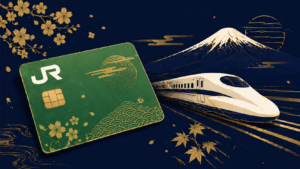
IC cards work across all of these. This is the single most important thing to understand — your Suica, PASMO, or ICOCA works on JR lines, subway lines, and most private railways without any configuration. Just tap in and tap out.
—
IC Cards: The Most Important Thing to Get Right
An IC card (Integrated Circuit card) is a rechargeable card that you tap on card readers to pay for transit. Think of it like a prepaid transit card in any major city — London’s Oyster, New York’s MetroCard — except it works almost everywhere in Japan and also works for paying at convenience stores, vending machines, and some restaurants.
Which IC Card to Get
| Card | Region | Where to Buy |
|---|---|---|
| Suica | Tokyo (JR East) | JR stations, Narita/Haneda airports |
| PASMO | Tokyo (private railways, subway) | Most Tokyo subway stations |
| ICOCA | Osaka/Kyoto/Nara (JR West) | Kansai stations, KIX airport |
All three work nationally. If you pick up a Suica in Tokyo, it will work in Osaka, Kyoto, and on the Shinkansen (for paying local fares — not for the Shinkansen itself). Just get whichever is available at your arrival airport.
How to Load and Use Your IC Card
Buy it: At any ticket machine in the station. Look for “IC Card” or the Suica/PASMO/ICOCA logo on the machine screen. Insert cash (1,000 JPY minimum), select your initial load amount, and collect the card. The 500 JPY deposit is included in your first purchase.
Tap in: Hold the card over the reader at the ticket gate — the green panel will flash and beep. The gate opens.
Tap out: When you exit at your destination, tap the card again. The system calculates the exact fare and deducts it.
Top up: At any ticket machine, or at convenience stores. Insert the card, select “Charge,” insert cash, done.
Check balance: The last fare deducted and remaining balance are shown on the ticket gate screen every time you tap out.
Minimum balance: If your balance drops below what the fare requires, the exit gate will not open and you will hear a different tone. Go to a “Fare Adjustment” machine (orange, near exits) and top up.
Getting a refund: Return the card at any JR service counter before leaving Japan — you get the 500 JPY deposit back plus any remaining balance (minus a 220 JPY handling fee).
Mobile IC card: If your phone supports NFC (iPhone 7+, most Android), you can add a digital Suica directly to your Apple Wallet or Google Pay. This works identically to the physical card.
—
Buying Tickets: When IC Cards Are Not Enough
IC cards cover local trains and subways. But they do NOT cover:
– Shinkansen (bullet train) journeys — separate ticket required
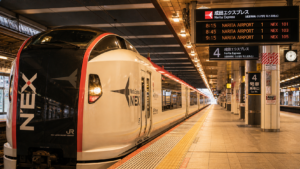
– Express trains with reserved seats (like the Narita Express, Keisei Skyliner)
– Some tourist-specific services
For these, you buy tickets at ticket machines in the station, at the green JR ticket counters (midori no madoguchi), or in advance online.
How to Use a Ticket Machine
- Select English on the touchscreen (every major station machine has English)
- Choose your destination from the route map (or search by name)
- The fare displayed is per adult. Select number of adults and children.
- Insert cash or credit card
- Collect ticket(s) and change
- Get your IC card at the airport (Suica in Tokyo, ICOCA in Kansai)
- Load 3,000 JPY onto it immediately
- Install Google Maps and Navitime on your phone
- Save your hotel address in Japanese in a note
- Check whether the JR Pass saves money for your itinerary before buying
- Book Shinkansen reserved seats for long-distance travel in advance if your trip falls during Golden Week (late April to early May), Obon (mid-August), or New Year
The ticket goes into the slot in the gate (not the card reader). Keep it — some gates require you to insert it again at exit.
—
The Shinkansen (Bullet Train)
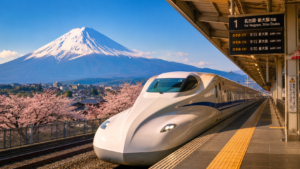
The Shinkansen is Japan’s high-speed rail network and one of the most reliable train systems ever built. It connects Tokyo with Osaka in about 2 hours 30 minutes (Nozomi/Hikari) and extends north to Hokkaido and south to Fukuoka.
Shinkansen Ticket Types
| Type | Seat | Advance Required? | IC Card? |
|---|---|---|---|
| Jiyuseki (unreserved) | Any unreserved car | No | No |
| Shiteiseki (reserved) | Your specific seat | Recommended | No |
| Green Car (first class) | Wider seats, quieter | Recommended | No |
| Nozomi/Mizuho (fastest) | Not covered by JR Pass | — | No |
My recommendation for beginners: Book a reserved seat for Shinkansen journeys. The price difference from unreserved is small (a few hundred JPY), you are guaranteed a seat, and you avoid the stress of finding a free car on busy travel days.
Book at the JR green ticket counter (midori no madoguchi) at any major station. Staff speak enough English to handle bookings, or you can use the self-service machines which have English menus.
The JR Pass Question
If you are doing multiple long Shinkansen journeys (Tokyo to Osaka, Osaka to Hiroshima, etc.), the JR Pass may save you significant money. But it is not automatically worth it for everyone. Read the full JR Pass guide to calculate whether it makes sense for your specific itinerary.
Browse Japan Activities on Klook →
—
Types of Trains: Local, Rapid, Express, and Limited Express
At any given station, multiple trains may serve the same line with very different stop patterns. Getting on the wrong one means either stopping everywhere (slow) or missing your station (too fast).
| Train Type | Japanese | Stops |
|---|---|---|
| Local (futsu) | 普通 | Every single stop |
| Rapid (kaisoku) | 快速 | Skips minor stops |
| Special Rapid (shinkaisoku) | 新快速 | Skips more stops, faster |
| Express (kyuko) | 急行 | Major stations only |
| Limited Express (tokkyuu) | 特急 | Few stops, often requires extra fee |
How to know which to take: Look at the destination boards on the platform and the front of the train. They show the train type and final destination. Google Maps and Navitime will specify which train type to board in their routing.
The key rule: Local trains (futsu) stop everywhere and are free with your IC card or regular ticket. Express and Limited Express trains often require an additional express fee on top of your base fare. This fee is charged even if you have a JR Pass (for most express services).
—
Navigating Major Stations
Major Japanese stations are large, complex, and beautiful in an overwhelming way. Shinjuku Station in Tokyo is the busiest train station in the world and has over 200 exits. Here is how to navigate any large station:
Find your line first: Look for the colored line markers (JR lines are green/various; Tokyo Metro lines each have a color and number). Follow the color to the right platform.
Read the platform signs: Platforms show the train type, destination, and next stop. The “next arrival” board shows arriving trains in sequence.
Use exit signs deliberately: At your destination, follow signs for the exit name your Google Maps route specifies. Large stations have named exits (A1, East Exit, South Exit) — hotels and attractions list which exit to use. This saves significant walking.
Ask for help: Station staff are at every major station. Show them your destination in Japanese (your Maps app, a written note, or your hotel booking) and they will point you to the right platform. This is completely normal.
—
Tokyo’s Train System: A Quick Overview
Tokyo has multiple overlapping networks:
– JR Yamanote Line: The circular line linking all major Tokyo hubs (Shinjuku, Shibuya, Harajuku, Akihabara, Ueno, Tokyo, Shinagawa). Most tourists use this constantly. Color: green.
– JR Chuo Line: Runs east-west through central Tokyo.
– Tokyo Metro: 9 lines covering the city in detail.
– Toei Subway: 4 lines supplementing Metro coverage.
A single journey within central Tokyo typically costs 170 to 300 JPY with an IC card. The 24-hour all-network tourist pass (1,600 JPY / ~$10.70) is worth it if you plan to make many short trips in one day.
—
Train Etiquette
Etiquette on Japanese trains is important. Full context is in the Japan etiquette guide, but the core rules for trains are:
– No phone calls. Silent mode, always.
– No eating on local trains or subways (Shinkansen is fine).
– Queue at the platform markers.
– Let passengers exit before boarding.
– Give up priority seats to those who need them.
– Speak at low volume or not at all.
– Earphones for music and videos.
Following these rules takes approximately zero extra effort and makes you a comfortable part of the system.
—
Practical Costs: What to Budget for Transport
| Journey | Approx. Cost |
|---|---|
| Single subway ride (Tokyo) | 170–300 JPY ($1.10–$2) |
| Yamanote Line full loop | 200 JPY ($1.30) |
| Tokyo to Osaka (Hikari Shinkansen) | 13,720 JPY ($91.50) |
| Tokyo to Kyoto (Hikari) | 13,320 JPY ($88.80) |
| Osaka to Kyoto (JR Rapid) | 580 JPY ($3.90) |
| IC card day in Osaka | 500–1,000 JPY ($3.30–$6.70) |
For a full per-day transport budget, see the Japan 1-week cost breakdown.
—
First Trip Checklist
Japan’s trains are a pleasure once you understand the system. Within two days of arrival, tapping IC cards and navigating platforms will feel completely natural. Trust the system — it almost never fails.