Last updated: May 2026
Affiliate disclosure: This guide contains affiliate links. If you book through them, we may earn a small commission at no extra cost to you. We only recommend services we’d use ourselves.
Japan Travel Checklist: 25 Things to Do Before Your Trip
Planning a trip to Japan is genuinely exciting, but it can also feel overwhelming the first time. The country has its own rules, its own systems, and plenty of moments where being unprepared costs you either money or a frustrating hour trying to figure things out on the spot.
I have been to Japan several times now, and every trip I refine my pre-trip routine. This checklist covers 25 things you should sort out before you board the plane. Work through these in the weeks leading up to departure and you will arrive confident, connected, and ready to enjoy every moment.
The three things to lock in early (most travelers leave them too late):
– Japan eSIM on Klook → — instant data the moment you land
– First-night hotel on Trip.com → — peak-season inventory disappears fast
– JR Pass on Klook → — must be purchased before you arrive
—
1-4 Months Before Your Trip
1. Book your flights (obviously)
Get this done first. Flight prices to Japan from North America and Europe fluctuate significantly, and booking at least 3-4 months out usually gets you a better deal. Tokyo (Narita or Haneda) and Osaka (Kansai) are the main entry points.
2. Decide on your JR Pass
The JR Pass is one of the most debated topics in Japan travel, and the answer genuinely depends on your itinerary. If you are doing the classic Tokyo-Kyoto-Osaka loop plus a few Shinkansen rides, it usually pays for itself. If you are staying mostly in one city, skip it.
The key thing: you must buy the JR Pass before you arrive in Japan. You cannot purchase it once you are there (at least not at the same price). Order it online with enough lead time for delivery, or purchase a digital exchange order.
Rule of thumb: If your Shinkansen rides will total more than 50,000 JPY (~$330 USD), the 7-day pass is likely worth it.
→ Order your JR Pass on Klook — digital exchange orders ship in days, and Klook regularly runs price-match deals.
3. Book accommodation in advance
Japan is one of the most visited countries in the world. Popular areas in Tokyo, Kyoto, and Osaka book out weeks in advance, especially during cherry blossom season (late March-early April) and autumn foliage (November). Check out the full accommodation guide for what to expect at each price tier.
Budget tip: Hostels and guesthouses in Japan are genuinely excellent. Do not be afraid of dorm beds — Japanese hostels are famously clean and well-run.
→ Compare Japan hotel prices on Trip.com — Trip.com tends to undercut Booking.com on Japanese inventory and has free cancellation on most rooms.
4. Apply for a travel credit card with no foreign transaction fees
If you do not have one already, apply now so it arrives before your trip. Cards like Chase Sapphire, Capital One Venture, or Wise work well. Japan is more cash-heavy than most countries, but having a card that does not charge foreign transaction fees (typically 1-3% per transaction) saves real money over a 2-week trip.
—
2-4 Weeks Before Your Trip
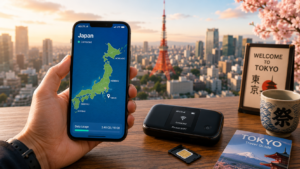
5. Sort your eSIM or pocket WiFi
Staying connected in Japan is non-negotiable. Google Maps alone will save you countless times per day. I strongly recommend an eSIM for convenience — you activate it before you land and you have data the moment you step off the plane.
Read the full eSIM vs Pocket WiFi comparison for detailed plan breakdowns and pricing, but here is the short version:
– eSIM (recommended): Cheap, instant, no hardware to return. Saily and IIJmio are solid options.
– Pocket WiFi: Better if you are in a group sharing data, but you have to pick it up at the airport and return it before leaving.
Prefer a pocket WiFi pickup at the airport instead? Reserve a pocket WiFi on Klook → — pick up at Narita, Haneda, or Kansai and drop it in a postbox when you leave.
6. Understand how much cash to bring (and where to get it)
Japan runs on cash more than almost anywhere else. Many restaurants, smaller shops, and vending machine-era businesses are cash-only. Plan to carry 10,000-30,000 JPY ($65-200 USD) in cash at any time.
The best ATMs in Japan are at 7-Eleven, Japan Post, and some Lawson convenience stores. They accept international cards with no drama. Avoid airport currency exchange counters — the rates are terrible.
Read the dedicated Japan money guide for the full breakdown on ATMs, IC cards, and Wise/Revolut.
7. Download your essential apps
These are not optional. Download all of these before you fly because airport WiFi is unreliable:
– Google Maps — Works perfectly for trains, buses, and walking
– Google Translate — Camera translation mode is genuinely magic for menus
– Hyperdia or Navitime — For detailed train routing including fares
– IC Card app (Suica or PASMO) — Load your transit card on your phone
– Klook or GetYourGuide — Book day trips and activities. Browse Japan activities on Klook → or see top tours on GetYourGuide →
The full apps guide covers these in more detail with setup instructions.
8. Get travel insurance
This one is non-negotiable for Japan. Healthcare is world-class, but without insurance, a hospital visit can cost thousands of dollars. Make sure your policy covers:
– Medical evacuation
– Trip cancellation
– Lost/stolen luggage
– Activity coverage (if you are doing skiing, hiking, etc.)
Many of the activities you’ll book through Klook and GetYourGuide also include their own activity-level insurance for skiing, diving, and adventure tours — worth checking the inclusions on each booking. Browse insured Japan experiences on Klook →
9. Make a rough day-by-day itinerary
You do not need a minute-by-minute plan, but having a rough framework prevents the paralysis of standing in Tokyo at 9am wondering what to do. At minimum, decide which cities you are visiting and on which days.
Starter resources:
10. Book Shinkansen reserved seats for busy periods
If you are traveling during Golden Week (late April-early May), cherry blossom season, or Obon (mid-August), book your Shinkansen seats as soon as your JR Pass is confirmed. Unreserved cars exist but fill up fast during peak periods, and standing for 2.5 hours to Kyoto is not fun.
Reserve Shinkansen tickets on Klook → — convenient if you’re not using a JR Pass for that specific leg.
11. Research entry requirements
Japan has no visa requirement for most Western passport holders for stays under 90 days. However, rules change, and some nationalities do need a visa. Check your government’s official travel advisory and the Japan Immigration Services Agency website to confirm current requirements.
12. Learn a few Japanese phrases
Japanese people are extraordinarily helpful even if they speak no English, and making even a small effort in their language goes a long way. The essential phrases:
| Phrase | Romaji | Meaning |
|---|---|---|
| Thank you | Arigatou gozaimasu | Thank you (formal) |
| Excuse me | Sumimasen | Excuse me / Sorry |
| Where is…? | …wa doko desu ka? | Where is…? |
| How much? | Ikura desu ka? | How much? |
| One please | Hitotsu kudasai | One, please |
| No thank you | Daijoubu desu | No thank you / It’s fine |
—
1-2 Weeks Before Your Trip
13. Set up a Suica or PASMO IC card on your phone
The IC card is how you pay for every train, subway, and bus in Japan. You tap in, tap out, and the fare is deducted. Modern iPhones and Android phones can load a Suica via Apple Wallet or the Suica app.
Alternatively, pick up a physical card at any major station when you arrive. Load 3,000-5,000 JPY ($20-33 USD) to start.
IC cards also work at convenience stores, vending machines, and some restaurants — I use mine for small purchases all the time. Pre-order a Welcome Suica on Klook → if you’d rather collect a card on arrival than fight the airport machine.
14. Research airport-to-city transport options
Getting from the airport to your hotel is its own mini-project. The options for Tokyo (Narita/Haneda) and Osaka (Kansai/Itami) are all different in price, speed, and convenience.
Read the airport to city guide for a full breakdown. The short version: the airport limousine bus is usually the best balance of price and convenience for first-timers with luggage.
Pre-book to skip the airport ticket queue:
– Narita Express tickets on Klook →
– Haruka Express (Kansai) on Klook →
– Private airport transfer on Klook → (worth it if you arrive late)
15. Book popular experiences in advance
These things sell out weeks ahead, especially in cherry blossom and autumn foliage season:
– teamLab digital art museums (Tokyo and Osaka)
– Arashiyama Bamboo Grove guided tours
– Nishiki Market cooking classes in Kyoto
– Tsukiji sushi breakfast experiences
– Robot Restaurant (book at least a week out)
Browse Japan Activities on Klook →
For small-group walking tours, food crawls, and English-led day trips, GetYourGuide’s Japan catalog → tends to have the most native-English experiences with verified reviews.
16. Understand restaurant etiquette basics
Japan has rules around food that are easy to violate without realizing it. A few key ones:
– Do not tip. Tipping is considered rude in Japan.
– Do not eat or drink while walking (especially in Kyoto).
– Say “itadakimasu” before eating (it is like grace/bon appetit).
– Most restaurants have a ticket machine at the entrance — buy your meal ticket before sitting down.
– Slurping noodles is normal and acceptable.
The Japan etiquette guide covers this in much more depth. If you’d rather learn by doing, a guided food tour on GetYourGuide → covers the etiquette in person while you eat your way through a neighborhood.
17. Pack light (seriously)
Japan involves a lot of walking. The average tourist walks 15,000-25,000 steps per day in Tokyo. A heavy bag will ruin you. Pack a bag you can comfortably carry for 30 minutes without stopping.
Also: Japan has excellent laundry facilities. Coin laundromats are everywhere, hotels have laundry service, and convenience stores sell travel-size everything. You do not need to pack 2 weeks of clothes for a 2-week trip.
Heading between cities and want to ditch the luggage for a day? Book Yamato luggage forwarding on Klook → — they’ll ship your suitcase hotel-to-hotel overnight for around ¥2,000.
18. Check the weather for your travel dates
Japan has four distinct seasons with very different packing requirements:
– Spring (March-May): Layers, light jacket
– Summer (June-August): Lightweight, breathable fabrics, it is genuinely hot and humid
– Autumn (September-November): Layers again, jacket for evenings
– Winter (December-February): Proper warm coat, especially for Hokkaido
Read the Japan summer and autumn travel guide if you are visiting during the warmer months.
—
The Week Before Your Trip
19. Confirm all accommodation bookings
Print or screenshot your reservation confirmations with addresses in Japanese. Taxi drivers and even some hotel staff may not read English addresses well. Having the address in Japanese (copy it from Google Maps) prevents confusion.
Still finalising your hotel list? Check final availability on Trip.com → — most rooms are free-cancellation until 48 hours before check-in, so you can lock in inventory now and adjust later.
20. Notify your bank of travel dates
Even with a travel card, your main bank account card can get flagged for fraud if it suddenly starts being used in Japan. A quick call or app notification prevents your card being frozen when you most need it.
21. Make photocopies of important documents
Carry photocopies of your passport, visa (if applicable), travel insurance, and return ticket — separate from the originals. In case of theft or loss, having copies speeds up the replacement process enormously.
22. Download offline Google Maps for Japan
In your Google Maps app, download offline maps for Tokyo, Kyoto, and Osaka. Even with an eSIM, there are subway areas with no signal. Offline maps have saved me multiple times.
23. Read up on train etiquette
Japan’s train system is genuinely the best in the world, but there are rules. Quiet carriages, no phone calls, priority seating, where to stand on the platform — these are taken seriously by locals.
The train guide for beginners covers all of this clearly. Also worth grabbing a regional pass before you go — Tokyo Subway 72-hour pass on Klook → pays for itself in 4 rides.
24. Pack a small day bag
Beyond your main luggage, you need a lightweight day pack for daily sightseeing. Something you can fold into your suitcase that holds a water bottle, umbrella, snacks, and a light layer. A basic drawstring bag or packable daypack works perfectly.
25. Charge all your devices the night before departure
This sounds obvious, but also: download your boarding passes, check in online, and have your hotel address ready. The first 3 hours of a Japan trip tend to be high-stress logistics — arrive as prepared as possible so you can relax the moment you clear customs.
—
Quick Reference Checklist
| Category | Item | Done? |
|---|---|---|
| Booking | Flights | |
| Booking | JR Pass (if applicable) | |
| Booking | Accommodation | |
| Booking | Key experiences/activities | |
| Connectivity | eSIM or Pocket WiFi | |
| Money | Travel credit card | |
| Money | Cash plan (ATM strategy) | |
| Money | IC card (Suica/PASMO) | |
| Apps | Google Maps (offline) | |
| Apps | Google Translate | |
| Apps | Train routing app | |
| Admin | Travel insurance | |
| Admin | Bank notification | |
| Admin | Document copies | |
| Knowledge | Basic Japanese phrases | |
| Knowledge | Etiquette basics | |
| Packing | Weather-appropriate clothing | |
| Packing | Light day bag |
—
Tick the Big Three Off This Week
Everything else on this list can wait. These three usually can’t.
1. Reserve your Japan eSIM on Klook →
2. Lock in your first hotel on Trip.com →
3. Pre-book one signature experience on GetYourGuide →
Final Thoughts
Japan rewards preparation more than almost any other travel destination. Not because it is difficult — it is actually remarkably foreigner-friendly — but because small preparations (a working eSIM, some cash, knowing how the train system works) completely transform the experience from stressful to seamless.
Work through this list over the weeks before your trip, and you will land at Narita or Kansai ready to hit the ground running. Trust me, your future self will thank you.
Related reading:
– Full budget breakdown for 1 week in Japan