Best Things to Buy in Japan: A Souvenir and Shopping Guide
Japan is one of the world’s great shopping destinations. Not just for luxury goods or electronics, but for the kind of everyday quality – a 200 JPY pen that writes better than anything you own, skincare from a drug store that outperforms your expensive serums, KitKats in flavors that do not exist anywhere else – that makes you want to fill an entire extra suitcase.
This guide covers what is actually worth buying, where to find it, and how to make the most of Japan’s excellent tax-free shopping system.
—
Tax-Free Shopping in Japan
First, the practical stuff. Foreign tourists in Japan are eligible for a consumption tax exemption (currently 10%) on purchases over 5,000 JPY ($33 USD) at stores displaying the “Tax Free” logo. This is legitimate and significant – on a 30,000 JPY ($200 USD) electronics purchase, that is 3,000 JPY ($20 USD) back in your pocket immediately.
How it works:
- Bring your passport
- Spend over 5,000 JPY at a participating store
- Ask for tax-free at the register
- Staff will process it, often attaching a receipt to your passport or scanning it
- The tax is either deducted at the register or refunded immediately in cash
Major department stores, electronics chains (Yodobashi, BIC Camera, Yamada Denki), and Don Quijote all participate. Some smaller shops do too – look for the “Japan Tax Free Shop” sticker.
Note: Tax-free goods must leave Japan with you and cannot be opened/used before departure. In practice, for small items like snacks and cosmetics, this is never enforced.
—
Snacks and Food
KitKats
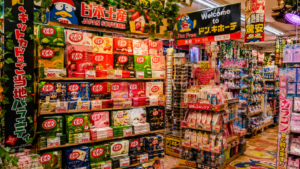
Japan’s KitKat situation deserves its own category. Nestle Japan has produced over 400 flavors since the early 2000s. The name sounds like “kitto katsu” in Japanese (“surely win”), which made them popular as good-luck gifts for students taking exams. Now they are a full-blown phenomenon.
Where to find them:
– Everywhere: 7-Eleven, Lawson, FamilyMart all carry seasonal flavors
– Tokyo Station: Has a dedicated KitKat Chocolatory with premium handcrafted flavors (300-500 JPY each)
– Airport souvenir shops: Wide selection specifically curated for gifts
Best reliable flavors: matcha, sake, wasabi, strawberry cheesecake, purple sweet potato. Buy the matcha ones at minimum.
Price: 150-250 JPY ($1-1.70 USD) for a bag of mini bars. Premium ones at the Chocolatory run 350-500 JPY ($2.30-3.30 USD) each.
Matcha Snacks in General
Beyond KitKats, Japan produces excellent matcha-flavored versions of everything: pocky, cookies, ice cream, chocolate, mochi, and dozens of regional items. Uji (near Kyoto) is the matcha capital – things you buy there will be noticeably higher quality.
Pocky and Other Snack Staples
Pocky comes in Japan-only flavors (almond crush, strawberry, regional editions) that are better and more varied than the export versions. A box costs 150-300 JPY ($1-2 USD).
Also worth buying: Calbee potato chips (sakura shrimp, nori butter flavors), Hi-Chew, Japanese gummy candies, and regional rice crackers (senbei).
Regional Specialty Foods (Omiyage)
Omiyage is the Japanese practice of bringing back food gifts from wherever you have traveled. Every region has its signature omiyage items, usually sold at train stations and airports:
– Tokyo: Tokyo Banana, Hiyoko cakes
– Kyoto: Yatsuhashi (cinnamon rice cakes)
– Osaka: Yaokin snacks, Osaka-specific sembei
– Hokkaido: Shiroi Koibito butter cookies, Royce chocolate
– Okinawa: Purple sweet potato tarts, Orion beer snacks
These make genuinely excellent gifts. A box of 8-12 pieces costs 1,000-2,000 JPY ($6.60-13 USD) and is far more meaningful than a generic magnet.
—
Beauty and Skincare
Japanese drug stores (drugstore chains like Matsumoto Kiyoshi, Sundrug, Cosme) carry skincare, haircare, and cosmetics at prices that are dramatically lower than equivalent quality products in the West.
The Best Drug Store Buys
Hada Labo Gokujyun Lotion: A hyaluronic acid toner/essence that has a cult following worldwide. About 800 JPY ($5.30 USD) for a large bottle. The export version is more expensive everywhere else.
Kose Softymo Speedy Cleansing Oil: Excellent makeup remover. About 700 JPY ($4.60 USD).
Canmake and Cezanne cosmetics: Japanese drugstore makeup brands that punch well above their price point. Eyeshadow palettes for 800-1,200 JPY ($5.30-8 USD).
Shiseido Anessa Sunscreen: The perfect UV + moisture hybrid. Expensive to import internationally. About 2,500 JPY ($16.50 USD) in a Japanese drugstore.
Pore strips and face masks: Sheet masks at 100-200 JPY ($0.66-1.33 USD) each are a popular buy. Biore UV cushion foundation packs are another popular drugstore buy.
DHC lip cream: Japan’s most popular lip balm. About 350 JPY ($2.30 USD).
Where to shop: Matsumoto Kiyoshi and Don Quijote both have excellent cosmetics sections, but standalone cosmetics chains tend to have better selection and staff knowledge.
—
Electronics
Japan’s electronics stores are a destination in their own right. Yodobashi Camera (massive, seven floors in Akihabara), BIC Camera, and Yamada Denki carry everything from noise-cancelling headphones to camera gear to the latest gaming hardware.
What Is Actually Worth Buying
Pocket cameras and lenses: Sony, Fujifilm, Canon, and Nikon are all Japanese companies. Prices are not always significantly cheaper than US/Europe, but you have access to Japan-market products not sold abroad.
Gaming hardware: Nintendo Switch accessories, Japan-exclusive game editions, Pokémon Center merchandise.
Portable audio: Sony and Panasonic audio gear. Japan tends to get premium variants first.
SIM-free phones: If you need a new phone and plan to use it with local SIMs anyway, Japan’s SIM-free market has competitive prices.
Cables, adapters, accessories: Japanese quality at reasonable prices, especially at Yodobashi.
Practical note: Electronics bought in Japan are often 100V/60Hz (vs 120V in the US or 240V in Europe). For items with a global power supply (like phone chargers, laptops), this does not matter. For items without (like rice cookers, hair dryers), you would need a voltage converter or buy a travel-specific model.
—
100-Yen Shop (Daiso, Seria, Can Do)
The 100-yen shop is genuinely one of Japan’s great contributions to human civilization. Everything costs 100 JPY ($0.66 USD) – or close to it – and the quality for the price is absurd.
What To Buy at Daiso
Kitchen items: Compact strainers, silicone spatulas, bento boxes, chopsticks, matcha whisks. All 100-110 JPY.
Organization: Cable organizers, storage boxes, travel bottles, ziplock-style bags.
Stationery: This is where Daiso gets really good. Notebooks, pens, sticky notes, washi tape, and craft supplies that would cost 5x more at a Western stationery store.
Travel accessories: Travel pillows, luggage straps, compression bags, passport holders.
Beauty tools: Face rollers, makeup sponges, nail files, eyelash curlers.
The main Daiso in Harajuku (6 floors) is a destination worth a dedicated hour. Seria is slightly more premium and often has better design aesthetics if you care about aesthetics in your 100-yen purchases.
—
Traditional Crafts and Gifts
What to Look For
Furoshiki (wrapping cloth): A versatile piece of fabric used for wrapping, as a bag, or as decoration. Beautiful patterns, 500-3,000 JPY ($3.30-20 USD) depending on quality.
Tenugui (hand towel): Thin cotton cloths with traditional Japanese patterns. Functional and beautiful. 500-1,500 JPY ($3.30-10 USD).
Chopsticks: Japan makes excellent chopsticks. A quality lacquered set in a box: 1,000-3,000 JPY ($6.60-20 USD). Avoid tourist-shop cheap ones.
Ceramics: Regional pottery (Kyoto-yaki, Arita-yaki, Bizen-yaki) is world-class. Prices range from affordable teacups at 1,500 JPY ($10 USD) to investment-level pieces.
Washi paper and stationery: Itoya in Ginza (Tokyo) is a 12-floor stationery paradise. Midori, Mark’s, and Yamamoto Paper make products that will change how you feel about notebooks.
Maneki-neko (lucky cat): The beckoning cat figurine. Kappabashi kitchen street in Asakusa has the best variety at wholesale prices.
—
Don Quijote (Donki)
Don Quijote – or “Donki” as everyone calls it – is a discount variety store that sells literally everything, crammed into narrow aisles with prices that feel almost chaotically low. It is overwhelming the first time. Here is how to approach it.
Donki strategy:
– Go for the cosmetics and beauty floor first (best prices in Japan for many brands)
– Check the snack section for large variety packs of Japanese treats at bulk prices
– Tax-free is available here – keep your passport
– The signage is chaotic by design (they actually research how to make it feel like a treasure hunt)
– Akihabara, Shinjuku, and Dotonbori (Osaka) locations are the largest
Best Donki buys: Cosmetics, snacks, cheap electronics accessories, character goods, sake/whisky (the liquor section has excellent prices on Japanese whisky).
—
What NOT to Buy
Generic samurai swords from tourist shops: Low quality, high price, difficult to get through customs.
Overpriced omiyage at tourist hotspots: The same items cost 40-50% less at the same brand’s shops elsewhere, or at supermarkets.
Electronics with Japanese-only power supplies: Unless you have checked the voltage compatibility, kitchen appliances in particular can be an expensive mistake.
Branded luxury goods: While Japan has excellent department stores, prices on Western luxury brands are not significantly lower than at home, and authenticity concerns are higher with gray-market items.
—
Budget Summary
| Category | Budget Option | Mid-Range | Splurge |
|---|---|---|---|
| KitKats (souvenir box) | 300 JPY ($2) | 600 JPY ($4) | 1,500 JPY ($10) at Chocolatory |
| Sheet masks (per piece) | 100 JPY ($0.66) | 300 JPY ($2) | 800 JPY ($5.30) |
| Daiso haul | 1,000 JPY ($6.60) | 2,000 JPY ($13) | 3,000 JPY ($20) |
| Traditional craft item | 500 JPY ($3.30) | 2,000 JPY ($13) | 10,000+ JPY ($66+) |
| Skincare item | 700 JPY ($4.60) | 2,500 JPY ($16.50) | 5,000 JPY ($33) |
| Electronics | 1,000 JPY ($6.60) accessory | 20,000 JPY ($133) camera | 100,000+ JPY ($660+) |
—
Final Thoughts
Japan rewards curious shoppers. Some of the best things I have bought here were things I stumbled on in a 100-yen shop or a regional train station souvenir stand. Come with some space in your bag, keep your passport handy for tax-free shopping, and resist the urge to buy everything in the first two days.
My one firm recommendation: pick up the matcha KitKats within the first 48 hours so you can assess whether you need to buy more before you leave. You will need to buy more.
Related reading:
– Japan budget breakdown for 1 week